
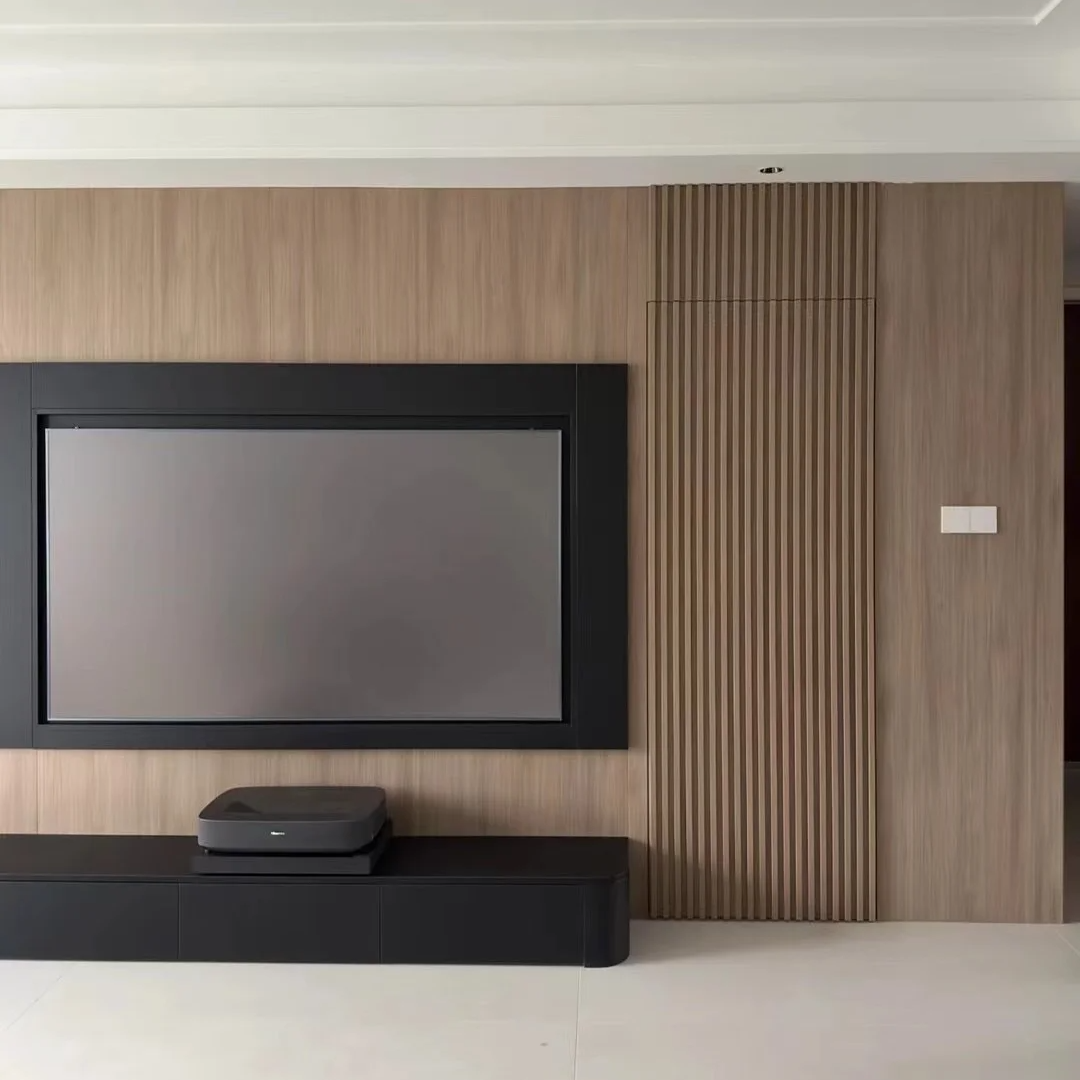
In contemporary interior design, wood remains an essential element—but the design logic has shifted.
Rather than emphasizing raw natural timber, designers now focus more on stability, visual order, and long-term consistency.
This is where wood-grain carbon crystal panels are increasingly applied as part of modern wall systems.
1. From Natural Randomness to Visual Order
Traditional wood celebrates irregular grain and natural variation. Modern spaces, however, favor:
- Controlled visual rhythm
- Consistent grain direction
- Long-lasting, distortion-free appearance
Wood-grain carbon crystal panels transform wood texture into a structured design element, allowing it to support spatial order rather than act as an unpredictable decorative feature. This makes them especially suitable for modern, minimalist, and high-end commercial interiors.
2. Guiding Space Through Vertical and Horizontal Layouts
Wall materials play a key role in shaping spatial perception:
- Vertical wood-grain layouts
Emphasize height and openness, ideal for apartments, hotel corridors, and spaces with limited ceiling height - Horizontal wood-grain layouts
Visually extend width and create a more relaxed atmosphere in public areas
Thanks to their consistent grain alignment, wood-grain carbon crystal panels allow these design strategies to be executed with precision.
3. A Low-Maintenance Design Philosophy for Commercial Spaces
In commercial and contract projects, design must balance aesthetics with long-term performance:
- No noticeable color variation over time
- Stable visual appearance year after year
- Reduced renovation and maintenance cycles
Wood-grain carbon crystal panels are widely used in:
- Hotels and hospitality projects
- Office interiors
- Retail and display spaces
The design concept is simple: design once, perform consistently for years.
4. A Restrained Wood Presence in Minimalist and Light-Luxury Interiors
In minimalist, modern Oriental, and light-luxury styles, wood is no longer the focal point—it becomes part of the background atmosphere:
- Calm, not dominant
- Warm, without being decorative
- Subtle, yet expressive
Wood-grain carbon crystal panels offer a refined and restrained wood expression, helping interiors achieve balance between warmth and visual clarity.
5. System-Based Wall Design Thinking
More projects now adopt a systematic wall design approach, rather than mixing unrelated materials.
Wood-grain carbon crystal panels are often used as:
- A primary wall surface
- A base material combined with stone, metal, or solid-color panels
- A unifying element in large-scale projects
This approach strengthens material consistency and improves repeatability across multiple spaces.
The value of wood-grain carbon crystal panels lies not in how closely they imitate real wood, but in how they make wood texture stable, controllable, and reliable.
They serve the space—not the material itself—supporting long-term design intent and spatial clarity.