In contemporary landscape design, the ground is no longer just a functional surface for walking—it is a key medium that connects architecture, nature, and human movement.
The value of landscape WPC decking lies in its ability to participate in spatial storytelling in a restrained and stable way, rather than competing for visual attention.
1. From Ground Covering to Landscape Language
Well-designed landscapes often use ground materials to define zones and guide circulation.
Landscape WPC decking is commonly used to:
- Direct pedestrian flow
- Distinguish circulation paths from resting areas
- Create a smooth transition between indoor and outdoor spaces
In this context, the decking becomes a subtle yet intentional spatial language.
2. A “Low-Presence” Approach to Natural Integration
Landscape design does not aim to make the ground the focal point. Instead, it emphasizes:
- Harmony with planting and water features
- Respect for the natural environment
- A calm and balanced visual atmosphere
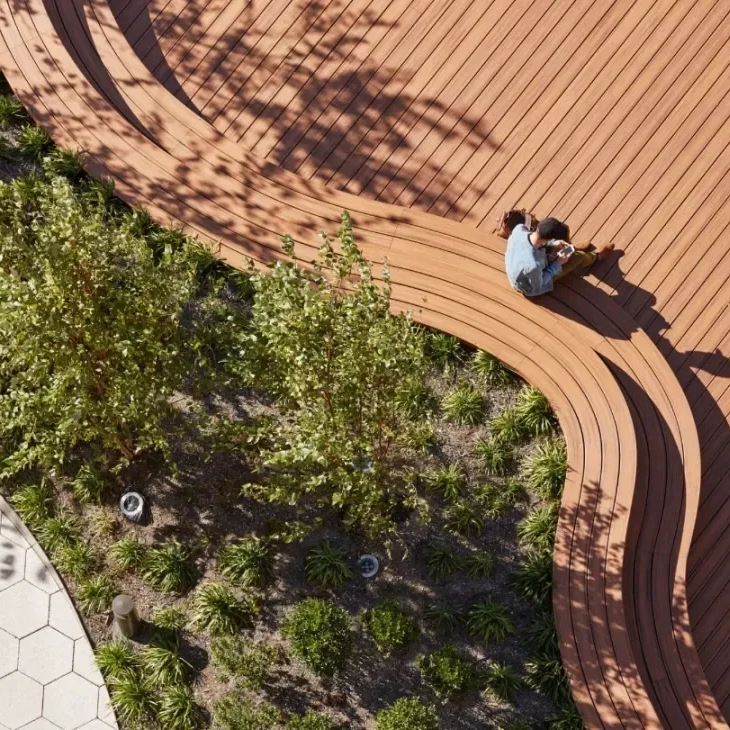
Through controlled color tones and consistent wood-grain rhythm, landscape WPC decking maintains a low visual presence, allowing nature to remain the primary focus.
3. Ground Rhythm and Spatial Perception
Decking direction and plank proportion directly influence how space is perceived:
- Linear layouts
Enhance a sense of movement and extension, ideal for walkways, waterfront boardwalks, and garden paths - Offset or transverse layouts
Create a sense of pause and relaxation, suitable for terraces, viewing decks, and outdoor seating areas
In landscape design, WPC decking functions as a rhythmic tool, not merely a material choice.
4. Long-Term Design Thinking for Public and Commercial Landscapes
Public and commercial outdoor spaces must perform consistently over time:
- Visual order remains intact
- Spatial logic does not degrade
- Maintenance does not disrupt the original design intent
For this reason, landscape WPC decking is widely applied in:
- Commercial plazas and outdoor platforms
- Hotel gardens and terraces
- Community and public landscape areas
The guiding principle is simple: design once, perform long-term.
5. From Single Surface to Systematic Landscape Design
Modern landscape projects prioritize material coherence.
Landscape WPC decking is often combined with:
- Stone paving
- Gravel zones
- Metal structures
- Planting systems
Together, these elements form a unified outdoor design system that ensures visual continuity and functional clarity.
Great Landscape Design Starts from the Ground Up
The true value of landscape WPC decking is not in how prominent it appears, but in how well it supports order, durability, and harmony within the landscape.
When ground design remains restrained, the landscape itself can truly take center stage.